LAB-004
How Much Concrete Do I Need? Pour Shapes Tested
Slab, footing, and cylindrical post-hole cases checked against independent volume arithmetic.
Research question
Does switching pour modes apply the correct geometry without carrying irrelevant dimensions into the result?
Finding: All four cases matched the independent volume calculations after cubic-foot-to-cubic-yard conversion and two-decimal display rounding.
Test method
- 01
Rectangular slab and footing cases use length × width × depth in feet. Post-hole cases use π × radius² × depth × count, with diameter converted from inches to feet before halving.
- 02
The selected reserve was applied only after net geometric volume was calculated. Cubic feet were divided by 27 to produce cubic yards.
- 03
Every case retained values for inactive fields, then verified that the selected mode ignored them. This catches a common form-state defect where hidden inputs continue affecting the result.
Expected calculation vs. actual result
The actual value is returned by the same engine used on the public calculator page.
| Case | Scenario and inputs | Expected calculation | Expected | Actual | Variance |
|---|---|---|---|---|---|
| C-SLAB | Rectangular slab12 × 10 ft slab; 4 in deep; 10% reserve | round((12 × 10 × 4/12 × 1.10) ÷ 27, 2) = 1.63 | 1.63 cubic yards | 1.63 cubic yards | 0 — match |
| C-FOOT | Linear footing30 × 2 ft footing; 12 in deep; 10% reserve | round((30 × 2 × 1 × 1.10) ÷ 27, 2) = 2.44 | 2.44 cubic yards | 2.44 cubic yards | 0 — match |
| C-POST12 | Twelve post holes12 holes; 12 in diameter; 3 ft deep; 10% reserve | round((π × 0.5² × 3 × 12 × 1.10) ÷ 27, 2) = 1.15 | 1.15 cubic yards | 1.15 cubic yards | 0 — match |
| C-POST10 | Narrow deeper holes10 holes; 10 in diameter; 4 ft deep; 5% reserve | round((π × (10/24)² × 4 × 10 × 1.05) ÷ 27, 2) = 0.85 | 0.85 cubic yards | 0.85 cubic yards | 0 — match |
What the results mean
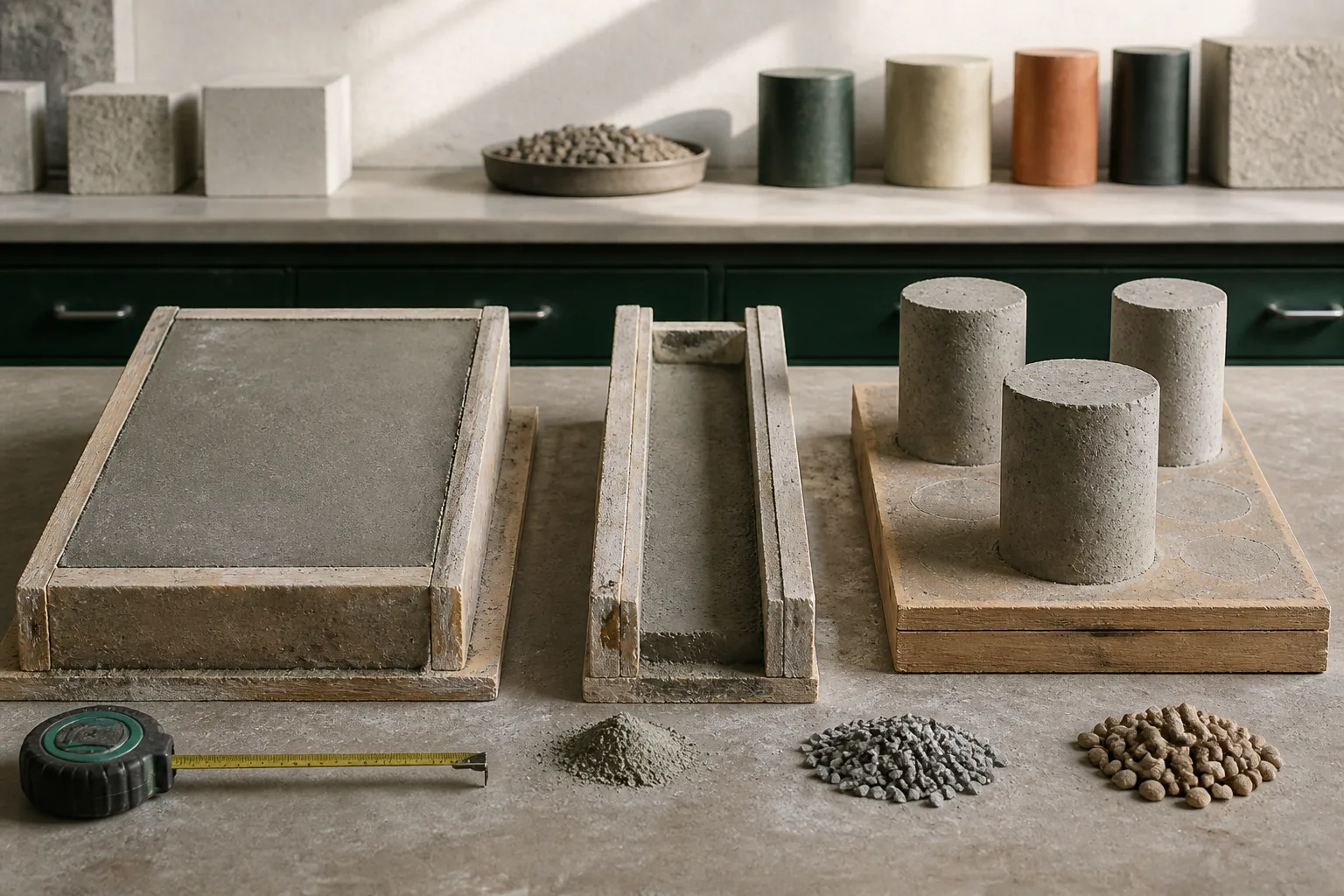
The slab and footing share rectangular arithmetic, but the labels matter because users measure them differently. The post-hole mode is materially different: treating a round hole as a square with the same diameter would overstate each cross-section by about 27%.
The displayed yardage is a geometric planning figure. Ready-mix suppliers may impose minimums or order increments, while bag yield comes from the chosen product. Neither commercial rounding nor excavation variation can be inferred from dimensions alone.
Mode separation improves auditability. A visitor can see which dimensions are active, reproduce the shape formula, and run each project component independently before combining supplier quantities.
Reproduce the result
For the slab row, convert four inches to one-third foot, then calculate 12 × 10 × 1/3 = 40 cubic feet. Add 10% to obtain 44 and divide by 27. For the footing, the 12-inch depth is exactly one foot, producing 60 cubic feet before reserve. These two rectangular cases can be reproduced with no geometric approximation beyond the stated uniform dimensions.
For the post-hole rows, convert diameter to feet and divide by two before squaring. The 12-inch case has a radius of 0.5 foot, so one three-foot hole contains π × 0.5² × 3 cubic feet. Multiply by 12 holes, then apply reserve and the 27-cubic-foot conversion. Keep π at full calculator precision until the final two-decimal result. Hidden slab dimensions remain in the input object but must not affect a post-hole result.
The CSV makes the inactive-field check visible because it retains the full input object for every mode. A reviewer can deliberately change the stored slab length in a post-hole case and confirm that output remains unchanged. If that unrelated field changes the result, the mode isolation has failed even if the published example values still appear plausible.
How to use this finding
- Measure depth after base preparation, not from an earlier excavation target.
- Calculate dissimilar pour components separately before combining them.
- Use the bag yield or supplier increment for the exact material being purchased.
Limits of this study
This is a modeled validation study of published calculator behavior. It is not a claim that a contractor, homeowner, or product consumed the modeled quantity in the field.
- Form movement, over-excavation, spillage, and consolidation are represented only by the chosen reserve.
- No structural design is performed.
- The model assumes consistent dimensions for repeated post holes.
Sources and assumptions
The sources below support the material context and assumptions. The expected arithmetic is shown directly in the dataset so the implementation check can be reproduced without accepting a hidden result.