
The calculation explained
Volume, subgrade, and ordering reality
All dimensions are converted to feet to find cubic feet, then divided by 27 for cubic yards. The reserve helps cover uneven excavation, form movement, spillage, and material left in the delivery chute. Bag output assumes roughly 0.60 cubic foot of mixed concrete per 80-pound bag.
Large pours are usually ordered in supplier increments, and short-load fees may matter more than a small volume difference. Verify slab thickness, reinforcement, base preparation, joints, curing, and local permit requirements with appropriate project guidance before placing concrete.
Complete planning guide
How to plan your concrete calculator estimate
Use the calculator for the arithmetic, then use this guide to check the measurements, assumptions, purchasing decisions, and field conditions behind the result.
Calculate placed volume, not surface area
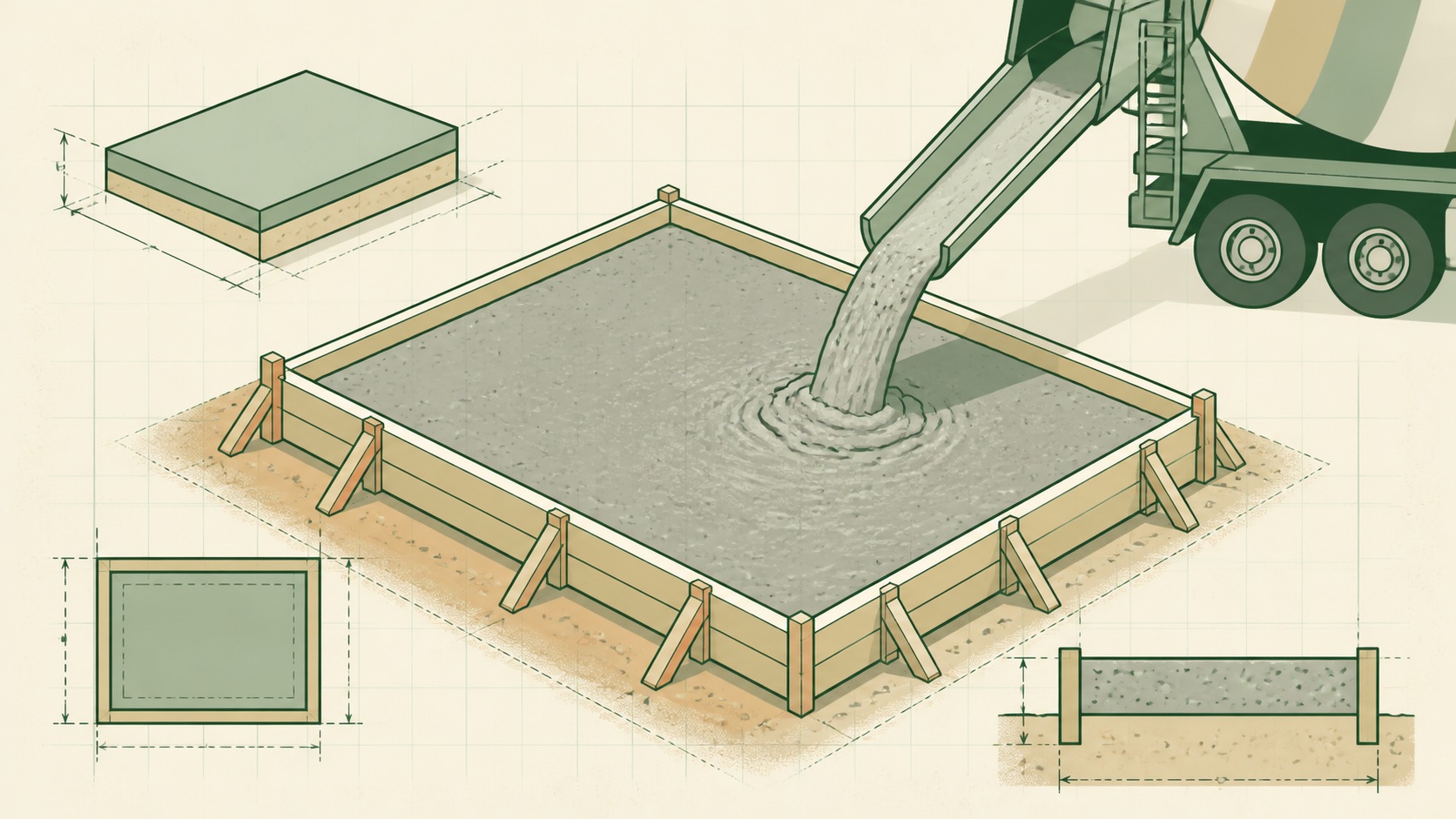
Concrete is ordered by volume. A slab that looks like a simple rectangle may include thickened edges, grade beams, footings, steps, piers, or a sloped profile that need separate volume calculations. The calculator multiplies length, width, and thickness, then converts cubic feet to cubic yards or to bag yield. The dimensions must describe the excavated and formed space because small thickness changes across a large area materially change the order.
Quantity does not determine mix design, reinforcement, joints, base preparation, or structural adequacy. Those decisions should follow project requirements, current supplier data, and experienced design where needed. Concrete also cannot be stretched by adding uncontrolled water without changing its properties. A sensible order includes a documented allowance for subgrade variation, form deflection, spillage, and material left in the truck or tools, while avoiding an arbitrary cushion that creates a large disposal problem.
Break the pour into solid shapes
Measure inside the forms. For each rectangular slab section, multiply length by width by thickness. Convert inches of thickness to feet by dividing by 12: four inches is 0.333 foot, not 0.4 foot. Add strips for thickened edges using only their extra depth so the normal slab thickness is not counted twice. Calculate rectangular footings as length times width times depth, round piers as pi times radius squared times depth, and steps as a set of rectangular solids.
Take several depth readings over compacted base rather than relying on one edge. A depression of one inch across many square feet can consume substantial concrete. For irregular plans, divide the footprint into rectangles and triangles; a triangle uses one-half times base times height. Add all cubic feet and divide by 27 for cubic yards. Bagged concrete must be converted with the yield stated for that bag size, since bag weight alone is not placed volume. Keep dimensions and deductions on a sketch that the crew can compare with the forms.
Worked example: patio with a thickened border
Imagine a patio formed 18 feet long by 12 feet wide at a nominal 4-inch thickness. Its volume is 18 times 12 times 0.333, or about 72 cubic feet. The design also has a 12-inch-wide border around the perimeter that is 4 inches deeper than the slab. The border's plan area is the full 216 square feet minus the 16-by-10-foot inner area, leaving 56 square feet. Multiplying by the extra 0.333-foot depth adds about 18.7 cubic feet.
Total geometric volume is approximately 90.7 cubic feet, or 3.36 cubic yards. If site inspection supports a 10 percent placement allowance, the planned quantity becomes 3.70 cubic yards. The supplier's minimum increment may lead to a 3.75- or 4-yard order. That rounding decision should consider measured base tolerances and access, not an expectation that excess can be discarded casually. If using bags for a much smaller pour, divide required cubic feet by the exact bag yield and round up to full bags.
Coordinate quantity with the pour
Ready-mix orders should state volume, delivery location, access constraints, placement method, timing, and the mix requirements already established for the work. Ask the supplier about order increments, short-load charges, truck capacity, standby policies, and how adjustments are handled. Confirm that forms, base, reinforcement, tools, labor, and a safe washout plan are ready before dispatch; quantity accuracy cannot rescue an unprepared placement.
For bagged products, compare yields rather than bag weights or prices alone. Verify water range, mixing capacity, working time, and whether one continuous placement can be completed with available labor. Buy a small deliberate reserve for variable depth and mixing residue, and plan an appropriate destination for mixed excess.
Common concrete-estimating mistakes
- Entering four inches as 0.4 foot overstates slab thickness by about one-fifth. Divide inches by twelve before multiplying dimensions measured in feet.
- Counting the full depth of a thickened edge after counting the slab duplicates the standard thickness. Add only the edge's depth below the main slab.
- Using plan area without checking excavated depth assumes a perfectly uniform base. Take enough field readings to find low spots, soft areas, and form variation.
- Dividing by 27 too early and rounding each shape can accumulate error. Add precise cubic-foot volumes first, then convert the total to cubic yards.
- Ordering exact geometric volume leaves no material for pump lines, chute residue, spillage, or minor over-excavation. Make the allowance explicit and proportionate to actual conditions.
Verify forms before dispatch
Measure the completed forms and base on pour day. Check length, width, depth at several points, thickened sections, footings, piers, blockouts, and penetrations against the takeoff. Recalculate each solid in cubic feet, sum once, divide by 27, apply the chosen field allowance, and round according to the supplier's ordering increment. Have another person independently inspect the largest dimensions.
Confirm mix designation, volume, truck sequence, placement route, crew, equipment, weather plan, and washout arrangement with the relevant parties. Resolve structural or specification questions before ordering rather than changing assumptions at the truck. The final number should match the forms that exist, carry a traceable allowance, and fit a placement plan capable of using the material within its working constraints.
Reproducible validation
How we tested this calculator
6/6 matched
Each row compares an independently stated expected result with the output returned by the published calculation engine. These are computational checks, not claims about material consumed in a field project.
| Case | Test inputs | Expected | Actual | Result |
|---|---|---|---|---|
| C-SLAB | 12 × 10 ft slab; 4 in deep; 10% reserve | 1.63 cubic yards | 1.63 cubic yards | Match |
| C-FOOT | 30 × 2 ft footing; 12 in deep; 10% reserve | 2.44 cubic yards | 2.44 cubic yards | Match |
| C-POST12 | 12 holes; 12 in diameter; 3 ft deep; 10% reserve | 1.15 cubic yards | 1.15 cubic yards | Match |
| C-POST10 | 10 holes; 10 in diameter; 4 ft deep; 5% reserve | 0.85 cubic yards | 0.85 cubic yards | Match |
| W-CN0 | 12 × 10 × 4 in slab; 0% | 1.48 cubic yards | 1.48 cubic yards | Match |
| W-CN10 | 12 × 10 × 4 in slab; 10% | 1.63 cubic yards | 1.63 cubic yards | Match |
Reference check
Sources and assumptions
Formula and assumptions reviewed by Alex Carter.
Volume is length × width × thickness, converted from cubic feet to cubic yards, with the selected reserve added. Bag yields and ready-mix quantities are approximate; excavation variation, subgrade, spillage, consolidation, and the exact product yield should be checked before ordering.
These references inform the method. The selected product label, supplier quantities, site conditions, and locally adopted requirements take precedence.
Before you buy
- 01
Measure depth at several points after compacting the base.
- 02
Confirm the supplier’s minimum order and rounding increment.
- 03
Do not begin a large pour without enough labor and finishing tools.
Common questions
Concrete Calculator FAQ
How many bags equal one cubic yard?+
At about 0.60 cubic foot per 80-pound bag, one cubic yard is approximately 45 bags before waste. Product yields vary.
Is ten percent reserve always needed?+
It is a planning default. Well-controlled forms may need less; rough excavation or deep footings can need more.