LAB-011
How Much Extra Material Should I Buy? Waste Compared
Six calculators compared before and after their published reserve settings to expose linear changes and purchase thresholds.

Research question
When a percentage allowance is added, which outputs move smoothly and which jump because materials are purchased in whole units?
Finding: Bulk outputs changed proportionally, while boxes, tiles, boards, and cartridges moved in discrete steps. A 10% allowance does not always produce 10% more purchase units.
Test method
- 01
For each calculator, geometry and product assumptions were held constant while reserve changed from zero to the tool’s published starting value.
- 02
Reference arithmetic was taken from each calculator’s stated formula. Bulk quantities retained their normal decimal precision; discrete packages and pieces were rounded upward.
- 03
The comparison is descriptive, not a recommendation that the same percentage should be used across materials. Its purpose is to verify implementation and show rounding behavior.
Expected calculation vs. actual result
The actual value is returned by the same engine used on the public calculator page.
| Case | Scenario and inputs | Expected calculation | Expected | Actual | Variance |
|---|---|---|---|---|---|
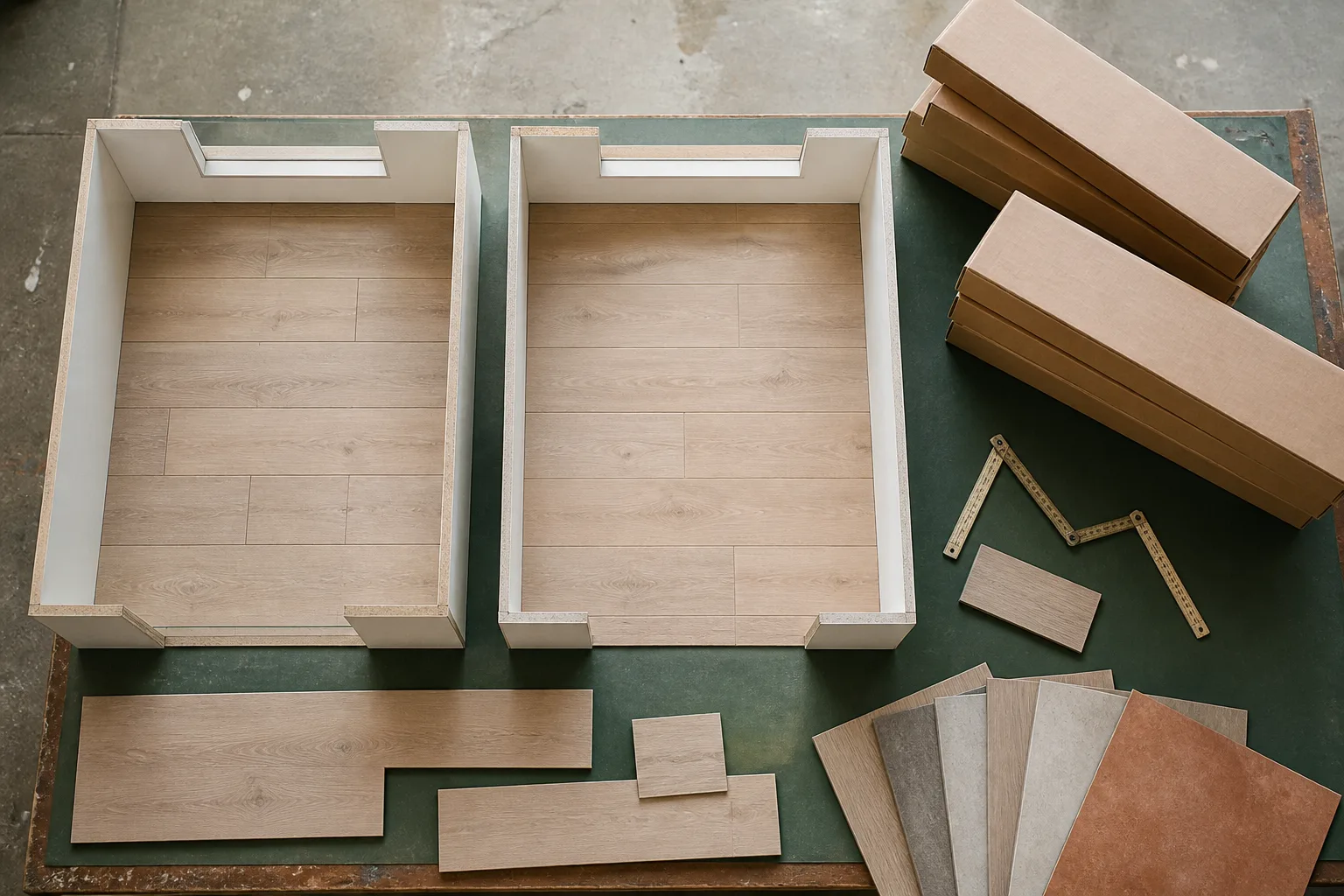
| W-FL0 | Flooring, no allowance192 sq ft; 22.5 sq ft/carton; 0% | ceil(192 ÷ 22.5) = 9 | 9 boxes | 9 boxes | 0 — match |
| W-FL10 | Flooring, 10%192 sq ft; 22.5 sq ft/carton; 10% | ceil(211.2 ÷ 22.5) = 10 | 10 boxes | 10 boxes | 0 — match |
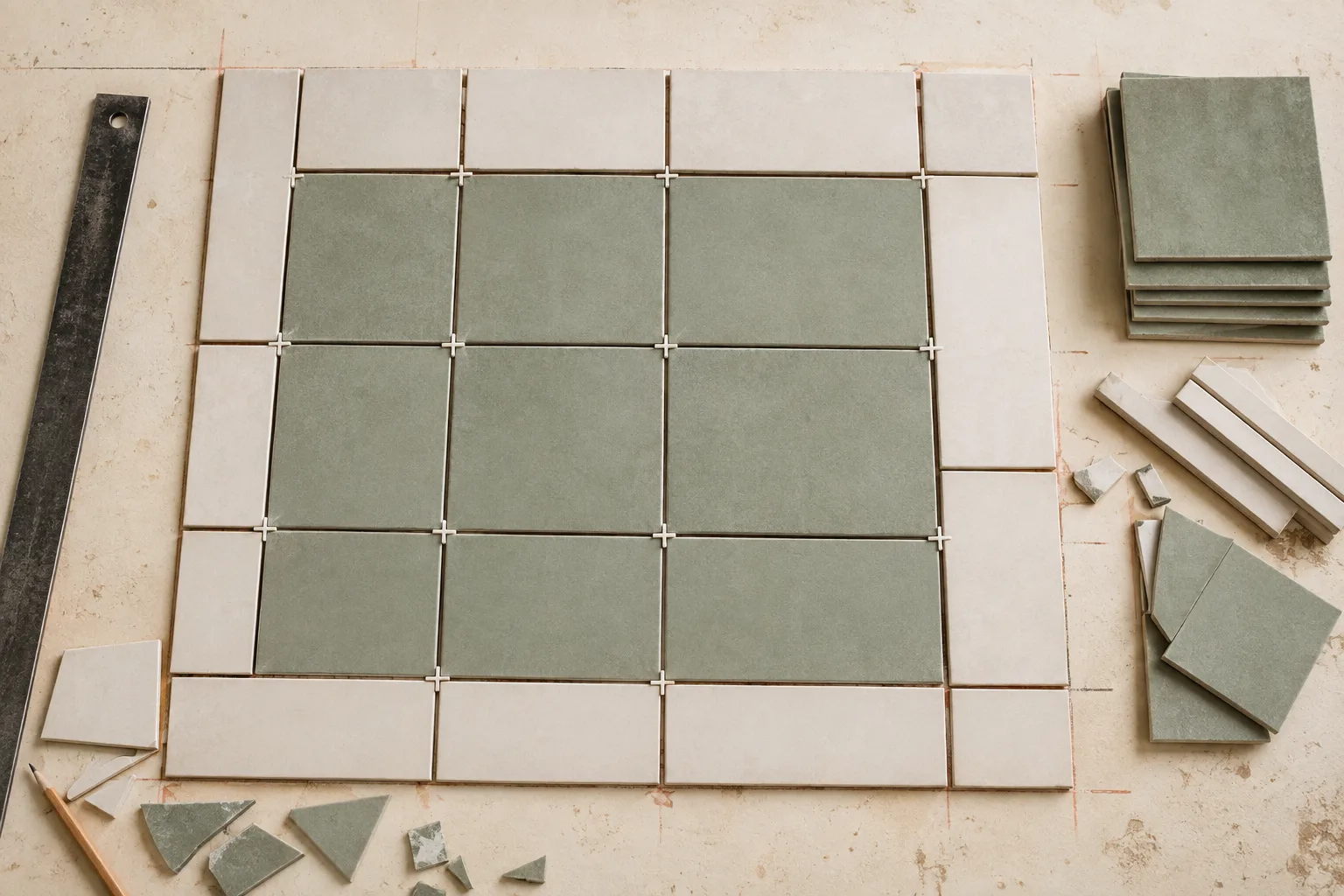
| W-TL0 | Tile, no allowance80 sq ft; 1 sq ft/tile; 0% | ceil(80 × 1.00) = 80 | 80 tiles | 80 tiles | 0 — match |
| W-TL12 | Tile, 12%80 sq ft; 1 sq ft/tile; 12% | ceil(80 × 1.12) = 90 | 90 tiles | 90 tiles | 0 — match |
| W-CN0 | Concrete, no reserve12 × 10 × 4 in slab; 0% | round(40 ÷ 27, 2) = 1.48 | 1.48 cubic yards | 1.48 cubic yards | 0 — match |
| W-CN10 | Concrete, 10%12 × 10 × 4 in slab; 10% | round(44 ÷ 27, 2) = 1.63 | 1.63 cubic yards | 1.63 cubic yards | 0 — match |
| W-MU0 | Mulch, no reserve24 × 6 ft × 3 in bed; 0% | round(36 ÷ 27, 2) = 1.33 | 1.33 cubic yards | 1.33 cubic yards | 0 — match |
| W-MU5 | Mulch, 5%24 × 6 ft × 3 in bed; 5% | round(36 ÷ 27 × 1.05, 2) = 1.40 | 1.4 cubic yards | 1.4 cubic yards | 0 — match |
| W-DK0 | Decking, no allowance192 sq ft; 5.5 in + .25 in gap; 16 ft stock; 0% | ceil((192 ÷ (5.75/12)) ÷ 16) = 26 | 26 boards | 26 boards | 0 — match |
| W-DK10 | Decking, 10%Same deck; 10% | ceil((192 ÷ (5.75/12) × 1.10) ÷ 16) = 28 | 28 boards | 28 boards | 0 — match |
| W-CK0 | Sealant, no allowance180 ft; .25 × .25 in; 10.1 fl oz; 0% | ceil(135 ÷ 18.227) = 8 | 8 tubes | 8 tubes | 0 — match |
| W-CK10 | Sealant, 10%Same joint; 10% | ceil(135 ÷ 18.227 × 1.10) = 9 | 9 tubes | 9 tubes | 0 — match |
What the results mean
Concrete and mulch display proportional volume changes because their primary outputs are bulk quantities. Flooring, tile, decking, and sealant cross whole-unit thresholds, so the percentage change in the purchase count can be smaller or larger than the entered reserve.
A waste percentage is a model input, not proof of field loss. Tile breakage, flooring pattern selection, concrete excavation tolerance, mulch settling, deck-board layout, and sealant tooling loss are different phenomena. The useful common feature is that the assumption remains visible and editable.
Users should select allowances from project-specific evidence: layout drawings, manufacturer guidance, supplier practice, measured conditions, and desired attic stock. Hiding one universal reserve inside every formula would make the calculators easier to misuse.
Reproduce the result
Reproduce the paired rows calculator by calculator rather than comparing unlike units. In each pair, first calculate net geometry with a multiplier of 1.00, then repeat with the stated reserve multiplier. For concrete and mulch, compare decimal bulk quantities. For flooring, tile, decking, and sealant, retain full precision and apply whole-unit rounding only after the reserve is included.
The difference between each pair is the combined effect of reserve and purchasing rule. For example, the flooring model rises from 192 to 211.2 square feet, a true 10% area change, while cartons rise from nine to ten, an 11.1% count change. The deck model rises from 26 to 28 boards, about 7.7%. Those percentages do not contradict the input; they demonstrate that discrete packaging converts a smooth quantity into steps. The CSV keeps both rows so this distinction can be recalculated directly.
How to use this finding
- Treat the default as a starting point, not a certification.
- Compare the unrounded material demand with the rounded purchase quantity.
- Record why a project-specific allowance was selected.
Limits of this study
This is a modeled validation study of published calculator behavior. It is not a claim that a contractor, homeowner, or product consumed the modeled quantity in the field.
- The benchmark measures calculator behavior, not field waste.
- Different output units should not be compared as though they were interchangeable.
- The tested defaults can change when editorial guidance or product evidence changes.
Sources and assumptions
The sources below support the material context and assumptions. The expected arithmetic is shown directly in the dataset so the implementation check can be reproduced without accepting a hidden result.
- Shaw FloorsHardwood flooring installation and planning guidance ↗
- DaltileTile product and installation FAQs ↗
- QUIKRETEConcrete and product quantity calculators ↗
- QUIKRETEMixing and placing concrete training guide ↗
- University of Minnesota ExtensionMulching for soil and garden health ↗
- TrexHow many deck boards do I need? ↗
- TrexHow to space deck boards ↗
- SikaHow to apply Sikaflex sealants ↗
- SikaSikaflex sealant coverage information ↗