LAB-010
How Much Caulk Do I Need? Joint Sizes Tested
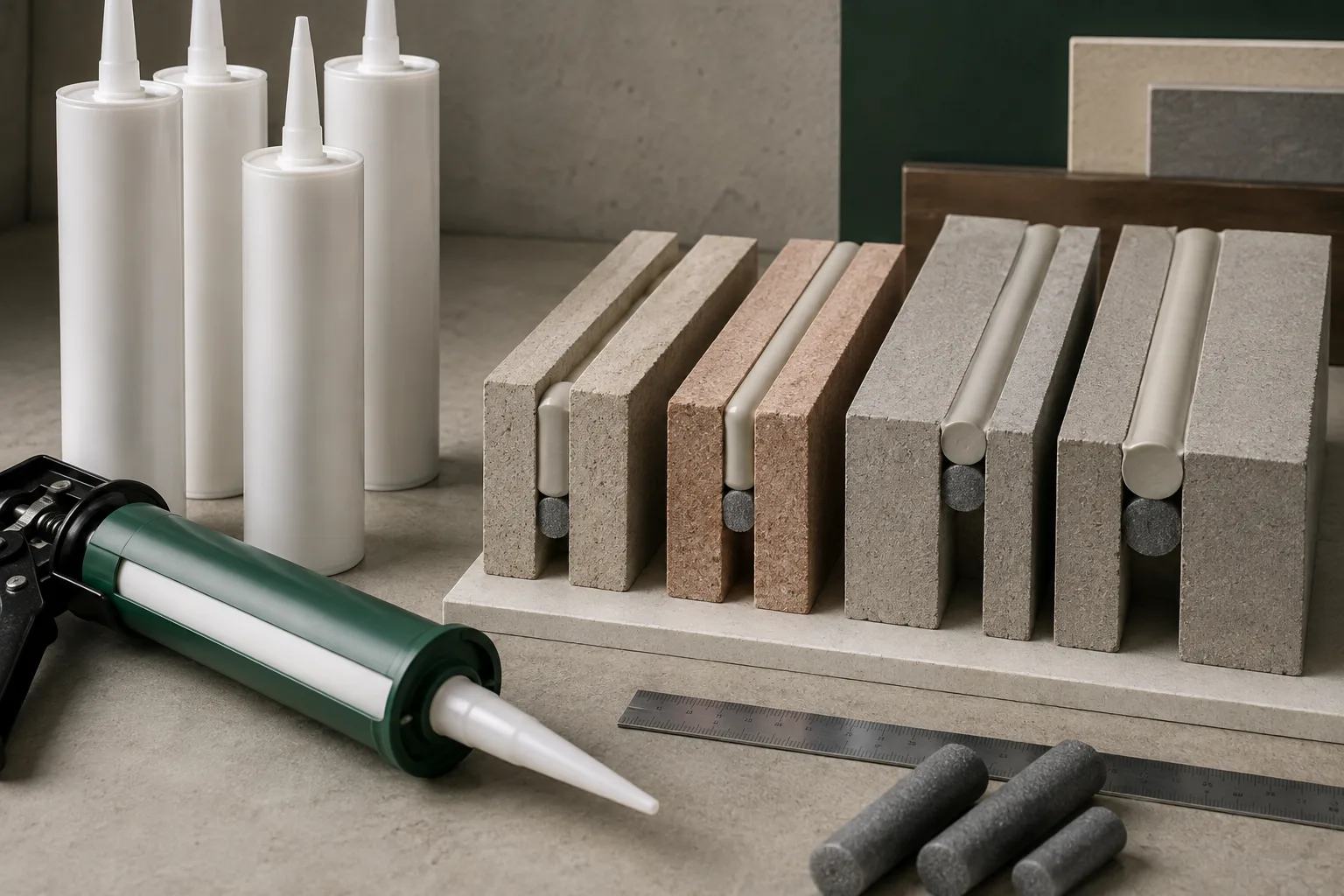
Four bead cross-sections show why width and depth must be measured instead of guessed.
Research question
How quickly does cartridge count rise when joint width and depth change over the same 180-foot run?
Finding: The modeled order increased from 9 to 19 cartridges across the tested cross-sections. Increasing both dimensions from one-quarter to three-eighths inch increased cross-sectional area by 2.25 times.
Test method
- 01
Joint length was fixed at 180 feet and converted to inches. Width × depth × length produced cubic inches for a rectangular bead.
- 02
A 10.1-fluid-ounce cartridge was converted using 1.80469 cubic inches per U.S. fluid ounce. A 10% waste allowance was applied before rounding upward to complete cartridges.
- 03
We tested width and depth separately and together, comparing each live output with the independent volume calculation.
Expected calculation vs. actual result
The actual value is returned by the same engine used on the public calculator page.
| Case | Scenario and inputs | Expected calculation | Expected | Actual | Variance |
|---|---|---|---|---|---|
| CK-025 | Quarter-inch square joint180 ft; 0.25 × 0.25 in joint; 10.1 fl oz; 10% waste | ceil((180 × 12 × .25 × .25) ÷ (10.1 × 1.80469) × 1.10) = 9 | 9 tubes | 9 tubes | 0 — match |
| CK-WIDE | Wider joint180 ft; 0.375 × 0.25 in joint; 10.1 fl oz; 10% waste | ceil((180 × 12 × .375 × .25) ÷ 18.227 × 1.10) = 13 | 13 tubes | 13 tubes | 0 — match |
| CK-BOTH | Wider and deeper180 ft; 0.375 × 0.375 in joint; 10.1 fl oz; 10% waste | ceil((180 × 12 × .375 × .375) ÷ 18.227 × 1.10) = 19 | 19 tubes | 19 tubes | 0 — match |
| CK-HALF | Half-inch wide, quarter-inch deep180 ft; 0.5 × 0.25 in joint; 10.1 fl oz; 10% waste | ceil((180 × 12 × .5 × .25) ÷ 18.227 × 1.10) = 17 | 17 tubes | 17 tubes | 0 — match |
What the results mean
Joint volume depends on cross-sectional area, so width and depth multiply. That is why a bead that looks only slightly larger can consume substantially more material over a long run.
Rectangular geometry is transparent but simplified. Many moving joints use backer rod to control depth and avoid three-sided adhesion, and some tooled surface beads are closer to a curved or triangular profile. Product guidance controls the intended joint design.
The waste setting represents starts, stops, nozzle fill, tooling loss, and irregularity. It does not compensate for choosing an incompatible sealant or ignoring preparation, temperature, cure, movement, and adhesion requirements.
Reproduce the result
Convert 180 feet to 2,160 inches before multiplying by joint width and depth. The quarter-inch square joint contains 135 cubic inches. Convert the 10.1-fluid-ounce cartridge to approximately 18.227369 cubic inches using the published factor, then divide joint volume by cartridge volume, multiply by 1.10, and round upward.
For the three-eighth-inch square row, cross-sectional area is 0.140625 square inch compared with 0.0625 for the quarter-inch row. The ratio is 2.25, so the unrounded cartridge demand should also be 2.25 times larger when length, cartridge size, and reserve remain unchanged. That relationship is a useful independent reasonableness check. A field takeoff should substitute the specified joint profile and should not model backer-rod-controlled depth as a fully filled cavity.
A cartridge-yield table can be audited with the same arithmetic in reverse. Multiply cartridge cubic inches by the number of cartridges, divide by the selected bead cross-section, then convert inches back to feet. That result is theoretical usable length before field loss. Comparing it with the forward calculation helps catch a misplaced conversion factor or an accidental use of fluid ounces as though they were cubic inches.
How to use this finding
- Measure a representative sample of joints at multiple locations.
- Use backer rod and depth control where the product detail requires them.
- Confirm cartridge volume and manufacturer coverage data before purchase.
Limits of this study
This is a modeled validation study of published calculator behavior. It is not a claim that a contractor, homeowner, or product consumed the modeled quantity in the field.
- The model assumes a rectangular filled cross-section.
- Field loss and irregularity are represented only by the reserve.
- No compatibility, adhesion, or movement-capability assessment is made.
Sources and assumptions
The sources below support the material context and assumptions. The expected arithmetic is shown directly in the dataset so the implementation check can be reproduced without accepting a hidden result.