LAB-003
How Many Extra Tiles Should I Keep? Reserves Tested
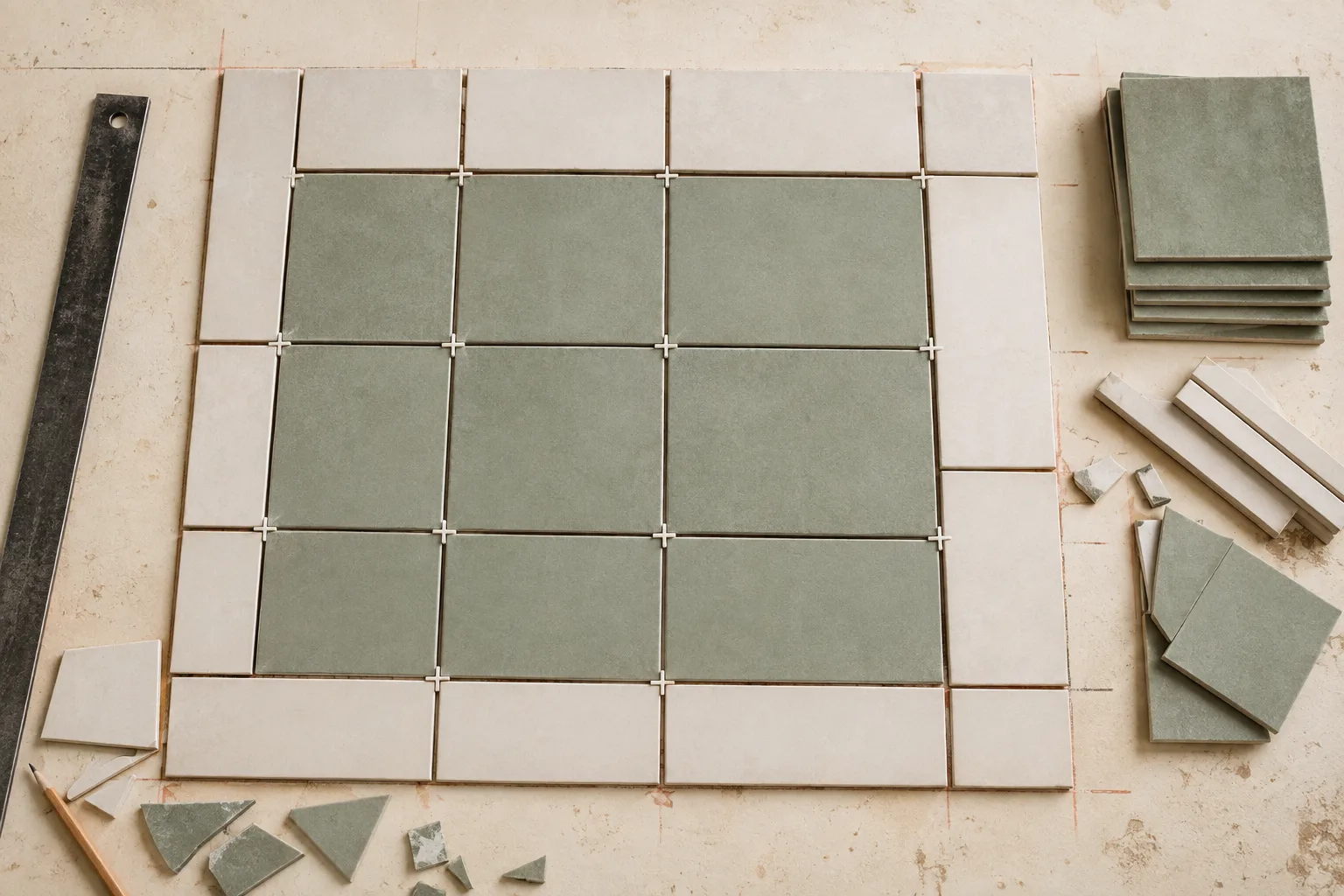
A fixed 80-square-foot field tested at four reserve levels, using 12-inch square tile.
Research question
How does a stated cut-and-breakage reserve translate into whole tiles on a simple rectangular surface?
Finding: On this exact one-square-foot tile module, each reserve percentage maps directly to area before final rounding: 80 tiles at 0%, 84 at 5%, 90 at 12%, and 96 at 20%.
Test method
- 01
The test surface is 10 × 8 feet. The tile face is 12 × 12 inches, exactly one square foot, which makes the expected count transparent and easy to audit.
- 02
The surface area was multiplied by 1 plus the selected reserve, then divided by tile face area. Fractional results were rounded to the next complete tile.
- 03
We compared four reserve settings while holding every geometric input constant. The test checks percentage handling, inch-to-foot conversion, and whole-piece rounding.
Expected calculation vs. actual result
The actual value is returned by the same engine used on the public calculator page.
| Case | Scenario and inputs | Expected calculation | Expected | Actual | Variance |
|---|---|---|---|---|---|
| T000 | No reserve10 × 8 ft field; 12 × 12 in tile; 0% reserve | ceil(80 ÷ 1 × 1.00) = 80 | 80 tiles | 80 tiles | 0 — match |
| T005 | Light reserveSame field and tile; 5% reserve | ceil(80 ÷ 1 × 1.05) = 84 | 84 tiles | 84 tiles | 0 — match |
| T012 | Published defaultSame field and tile; 12% reserve | ceil(80 ÷ 1 × 1.12) = 90 | 90 tiles | 90 tiles | 0 — match |
| T020 | Patterned-layout proxySame field and tile; 20% reserve | ceil(80 ÷ 1 × 1.20) = 96 | 96 tiles | 96 tiles | 0 — match |
What the results mean
This clean case is a baseline, not a recommendation for every layout. A centered field can create two cut pieces per row, while a diagonal or patterned design can consume offcuts faster. Fragile material and visual selection can also justify a larger reserve.
The calculator intentionally ignores the small area contributed by grout joints. That conservative choice avoids claiming that joint width will always reduce the order, because the actual number of rows, columns, and perimeter cuts controls whether that theoretical gain is usable.
Reserve tile can also serve a different purpose after installation: matching repair stock. If a color, caliber, or production lot is discontinued, unused pieces from the original order may be more valuable than a mathematically minimal purchase.
Reproduce the result
The chosen 12 × 12-inch tile deliberately makes one piece equal one square foot. Reproduce the field as 10 × 8 = 80 square feet, then multiply 80 by 1.00, 1.05, 1.12, and 1.20. Apply the upward whole-piece rule to each result. The 12% row produces 89.6 before rounding, which is why the published purchase quantity is 90 rather than 89.
A useful follow-up is to keep the field and reserve fixed while replacing the tile face with the actual measured dimensions of a selected product. Convert tile length × width from square inches by dividing by 144, then divide adjusted field area by that result. This does not become a cut-layout optimizer, but it verifies the unit conversion and shows why nominal size should not automatically replace an actual product dimension.
The row identifiers remain stable so a future formula change can be compared against the same baseline. When reproducing in a spreadsheet, label the unrounded piece demand separately from the purchase count. That prevents a visually rounded value such as 89.6 from being confused with 89 pieces and makes the upward rounding rule explicit to another reviewer.
Repeat the check with zero reserve first; it provides a clean control for every later layout experiment and makes accidental double-counting easier to spot.
How to use this finding
- Dry-lay or sketch the first rows before selecting a reserve.
- Convert the piece result to full cartons using the actual pieces-per-carton label.
- Keep production-lot information with stored repair pieces.
Limits of this study
This is a modeled validation study of published calculator behavior. It is not a claim that a contractor, homeowner, or product consumed the modeled quantity in the field.
- This study does not optimize a physical cut layout.
- It uses actual face dimensions supplied by the user.
- Pattern repeats, mosaics, borders, and shade selection need separate takeoffs.
Sources and assumptions
The sources below support the material context and assumptions. The expected arithmetic is shown directly in the dataset so the implementation check can be reproduced without accepting a hidden result.